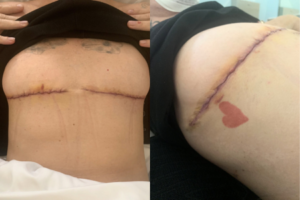

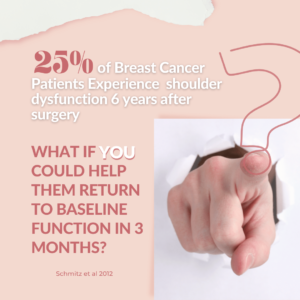
Research has shown that 21% of breast cancer patient experience shoulder dysfunction (classified as ‘poor’ on the DASH outcome measure) 6 weeks after surgery, and 25.6% 6 years later (Schmitz et al, 2012). However, shoulder dysfunction drops to just 4% when early rehabilitation is implemented! (Springer et al, 2010). Serratus anterior dysfunction is just one of many reasons for shoulder dysfunction in breast cancer patients.
 Serratus anterior (SA) holds the scapula to the wall of the thorax. When you reach overhead, this cooperative muscle forms a force couple with the upper and lower trapezius allowing for maximal upward rotation of the glenohumeral joint. Coined ‘the boxer’s muscle,’ serratus anterior translates the scapula forward during shoulder protraction packing a powerful punch. A compromised serratus anterior muscle can lead to altered timing in glenohumeral rhythm and scapular stabilization.
3 WAYS SERRATUS ANTERIOR IS AFFECTED:
- Lymph Node Dissection and Brachial Plexopathy: The long thoracic nerve innervates the serratus anterior. During axillary lymph node dissection the brachial plexus can be injured. A study by de Almeida Rizzi et al, 2016 showed that 8% of breast cancer patients have a winged scapula after lymph node dissection.
-
Implant placement & shoulder mechanics: Interventions such as mastectomy, reconstruction and radiotherapy can lead to rounded shoulders and upper cross syndrome. For example, implants are usually placed under the pectoralis major muscle and a portion of the serratus anterior may be lifted from the lower ribs. People with upper cross syndrome demonstrate weaker serratus function and tight pectoralis major and upper trapezius muscles (Rana et al, 2020).
- Radiotherapy : Radiation to the chest wall and axilla can lead to rotator cuff dysfunction and adhesive capsulitis. The area radiated for breast cancer is called the ‘mantle field’ and can compromise structures here including the long thoracic nerve. Although breast cancer patients are less likely to have significant neuromuscular sequelae compared to Hodgkins lymphoma patients, these deficits are more prevalent and significant with radiation due to recurrence (Stubblefield, 2017).
 Grab this free handout of Scapular Stabilization Exercises designed for breast cancer patients! More done-for-you handouts are available in The Breast Bundle. If you are a rehab practitioner wo is interested in learning how to prevent and treat all the side effects of medical intervention for breast cancer, check out the course ‘Breast Cancer Rehabilitation; Comprehensive Evaluation & Treatment’, This course was originally written in 2013 and has been updated and taught globally, but now it is available in the comfort of your own home!